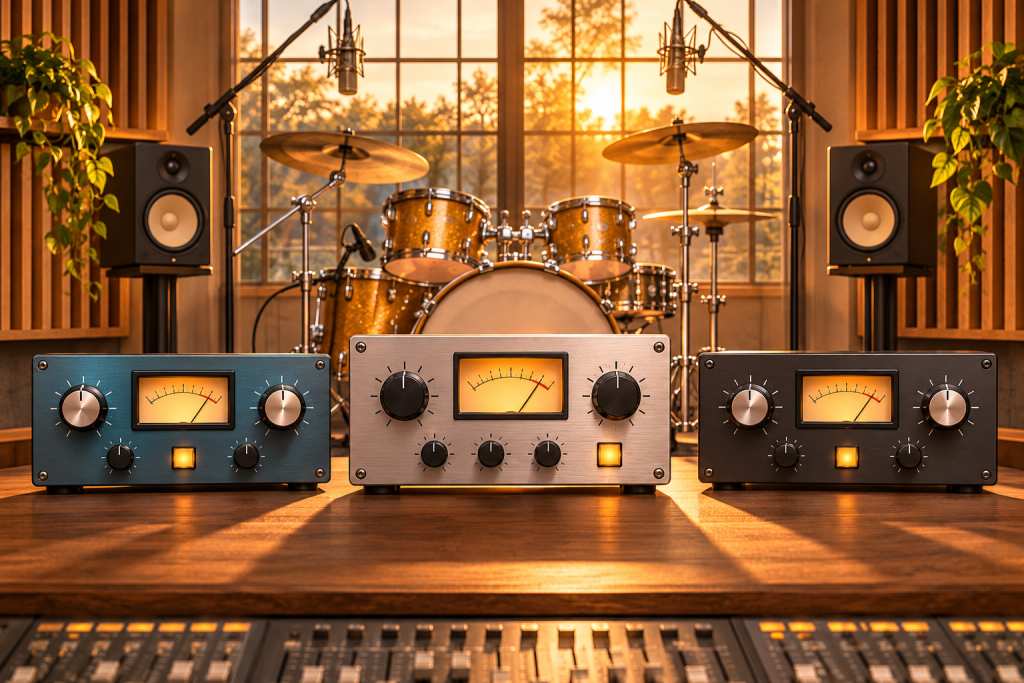
I keep two bus compressors on the drum group and neither of them costs more than a decent night out. That is not a brag about being cheap. It is what years of hearing my own kicks get smaller taught me: the price tag tells you next to nothing about whether a compressor grabs a drum bus the way I want it to.
What follows are the ones I actually reach for when I want punch under $100, with the settings and the trade-offs laid out. I will be honest about which ones fight you and which ones flatter everything.
What punch actually means on a drum bus
Punch is not loudness. It is the sense that the transient survives the compression and the body behind it gets pulled up tight. A slow enough attack, a fast enough release, and a ratio low enough that the whole kit still breathes.
Get the attack wrong and you flatten the snare. Get the release wrong and the compressor never lets go between hits, so by the second bar the groove is leaning backwards. The box matters less than those two knobs.
The SSL-style bus compressor, and why it is still my default
The classic SSL bus compressor has a punchy, energetic character that glues a mix together, and there are plugin versions across the board, from SSL themselves to Waves, IK Multimedia, Slate Digital, Universal Audio, Cytomic and Native Instruments. Several of those land under $100, and the emulation quality across the good ones is close enough that I pick on workflow rather than sound.
My starting point for drums is deliberately boring. Slow attack, fast release, 2:1, and barely any gain reduction on the meter. I creep up from there. That recipe gives me the glide between kick and snare without touching the front of either.
Where SSL-style comps fall down is exactly where they get praised: they add a sheen to everything. On a clean, low-slung house drum bus that sheen can read as smeared. I still keep one loaded, but I am not precious about swapping it.
The ones worth your cash
I won’t claim this covers the whole field. These are the four I have run hard on drums and kept.
Cytomic The Glue
My most-used. It is an SSL-inspired design with a very fast reaction and a mix knob that lets me dial the crush back without reloading. The range knob and the sidechain filter are what sell it; I filter the low end so the kick stops triggering the whole bus and making the rest of the kit pump against it. Under $100 and it behaves.
Arturia CompFET 76
A 1176 in spirit. It is fast, aggressive and adds character you can feel, and the 1176 lineage goes back to Bill Putnam’s design in the late sixties, with the sound turning up on everything from disco 12-inches to arena rock anthems. On drums I use it as the first compressor in a pair, catching the front of the hit, then let something slower smooth the tail. That two-stage approach is exactly what the vocal chain people describe, fast one first, gentler one after, and it works just as well on a kit.
The Arturia sits in the budget tier where I would actually trust it blind. It colors, but the color is useful on drums.
Tone Projects Unisum
Billed as a mastering compressor and usable well beyond it. I have leaned on it for drum buses where I want movement without the top end getting glassy. It is more surgical than the SSL clones and the learning curve is real, but for a house drum bus that needs to pump slightly and stay intact, it earns its keep. Tone Projects is a small shop with only a handful of products, and the quality shows.
Soundtoys Devil-Loc Deluxe
An emulation of the Shure Level-Loc from the 1960s, with crush, crunch, slow or fast release, a darkness control and a mix knob. It is not subtle. On a drum bus it can turn a polite loop into something with teeth, and automated parameters can give you movement that a static compressor never will.
It is also the one I would never put on the master. It is a flavor, not a tool, and the price sits comfortably under the hundred line for what it does.
What about the free ones?
You can get a lot of the way there for nothing, and I would be lying if I said the paid ones do something the free ones can’t.
OTT began as an Ableton preset and turned into an EDM staple for one reason: Steve Duda’s multiband up/down compressor slaps instant punch and brightness on whatever you feed it. It is aggressive by design and a little goes a long way, but with restraint it will transform a drum bus. It is not a glue compressor in the SSL sense; it is a character compressor that changes the energy.
Analog Obsession makes a free FET-style emulation called Fetish that is fast, aggressive and characterful, excellent on drums where you want compression you can feel. Xfer’s OTT and that FET box together cover a big part of what I use the paid ones for.
Fircomp 2 is worth a mention because it became one of the go-to mixing compressors in 2025 after the developer re-released it as freeware, and it is clean, transparent and flexible enough for subtle control or limiter duty. The learning curve is steeper than the SSL clones. When it clicks, it clicks.
How I actually stack them
On a drum bus I run two stages most of the time. A fast FET-style first to grab the transient and add weight, then an SSL-style stage to glue the kit and pull the tail in. The order matters. If I put the glue first the transients get smoothed before the FET ever sees them.
Settings stay boring. Low ratios on the second stage, gain reduction small enough that I have to look at the meter to notice it. If it sounds loud, I am doing it wrong; the compressor should sound like the kit got tighter, not louder.
The settings I would give you if you asked for a starting point
- SSL-style glue: 2:1, slow attack, fast release, sidechain filter so the kick stops triggering the whole bus.
- FET stage: medium attack, fast release, gain reduction in small bites rather than one big push.
- Character comp (OTT, Devil-Loc): mix knob well short of full, automate for movement, never leave it static across a whole track.
Start there and adjust by ear. The compressor is not the last step on the bus; it is the foundation the rest of the processing sits on.
What I would skip
The mastering brickwall boxes. They look like they belong on a drum bus because they flatten things, but a drum bus needs the transients alive. Reach for a mastering compressor when you are gluing the whole mix, not the kit.
And the plugins that promise to make everything loud. If the compressor’s job is making the bus louder, it is doing a different job than the one I want under a hundred dollars.