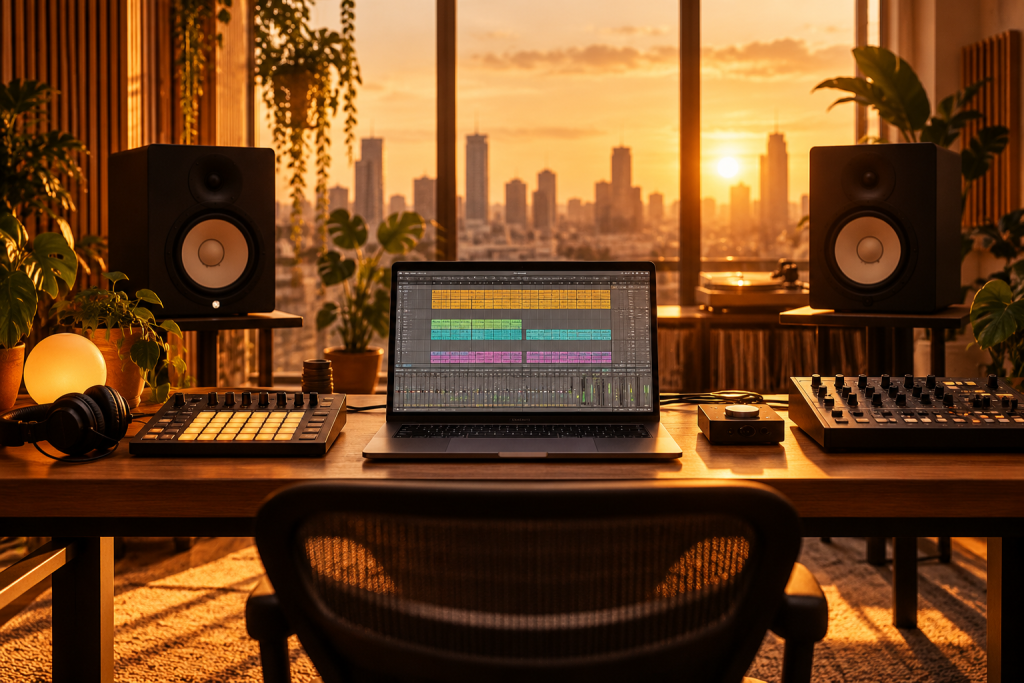
I have no verified details on a 12.2 update, so I’m not going to invent a feature list for it. What I can do is talk honestly about the groove tools that shipped in Live 12 proper, because those are the ones reshaping how I build house. The timing and migration behaviors for any later point release I don’t have solid grounding for, so treat the specific version framing with caution.
Live 12 brought a new suite of MIDI tools aimed at generating melodic and harmonic ideas, per MusicRadar’s review of the release. For a house producer, the interesting part isn’t the idea generation so much as what those tools do to timing and swing.
What actually changed in Live 12
Three things matter to me. The MIDI tools suite, the Meld synth, and Roar, Ableton’s colouring and saturation device. Auto Shift and Drum Sampler arrived with 12.1, so the update cadence has been steady; I’d expect any 12.2 to refine rather than reinvent. The full feature list for a 12.2 I can’t confirm. I won’t pretend otherwise.
The non-linear Session View is still the heart of the workflow, and the reason so many of us stay. Building loops and clips on a grid, jamming basslines against drums without hitting stop, that’s the part FL Studio users call cooking up beats on the fly. Live does it its own way. The clip grid and the arrangement timeline sit side by side.
Groove is a timing decision, not a plugin
Here’s my position after years of building house records. Swing and groove live in the placement of notes, not in the effect chain. You can stack saturation and compression until the low end is a wall, and if the hats sit dead on the grid it’ll still feel stiff. The groove pool and the MIDI note tools are where I make those calls now.
Ableton’s Warp and Complex Pro algorithm keeps a 110 BPM acapella convincing when you drag it up to a 128 BPM house tempo, formants intact. That timing flexibility is half of why so many club records get assembled in Live in the first place. Tracks come in off-beat, you drop warp markers, and they lock to your groove. The other half is that clip launch workflow letting me audition two different bass takes at 128 and feel which one swings.
My process on the new MIDI tools, in order:
- Write the kick and the main bassline first. Get the fundamental pocket right before anything else enters the picture.
- Use the groove tools to nudge the hats and percussion off the click. Small moves. If you can hear the swing as an effect, it’s too much.
- Layer in the Meld synth for texture, not melody. It’s built for experimental sound design territory and that’s exactly where I want it, underneath the arrangement.
- Only then reach for Roar on the drum bus.
The saturation goes after the groove is set, never before. Roar brings weight and forward motion, but it amplifies whatever timing problem you already had. Fix the pocket first. Colour second.
The browser and UI changes matter more than they sound
A modernised browser and more flexible UI arrived with Live 12, and neither gets the attention the synths do. They should. The browser categorises your own samples for you and saves complex searches, so a filter for a specific 808 character comes back in one click. When I’m deep in a session and hunting for the right kick fundamental, that recall is worth more than another oscillator.
The UI is now customisable, so I can pull the mixer up alongside arrangement view. For mixing a house track where the kick and sub have to sit right together, that side-by-side view cuts a lot of clicking. Small thing. Adds up over a session.
MusicRadar flagged that some of Live 12’s advances felt like they were due a little refinement in future updates, with subtle tweaks to the MIDI tools and browser expected. That’s the honest state of things. The groove tools are good. They’re not perfect, and anyone claiming the timing features are fully dialed in hasn’t spent a long night fighting them.
Where Live still frustrates a house producer
It’s expensive. The Suite tier runs $749, and Push 3 is another $999 if you want the hands-on integration, which genuinely turns the software into a physical instrument. That’s a real outlay.
There’s no clean answer on whether a 12.2 update justifies the upgrade cost for you. I can’t confirm its contents, so I won’t sell you one. If you’re already on 12, the groove tools you have are the ones doing the work on your low end and your swing. If you’re on an older version and your mixes feel static, the timing and browser improvements alone are a stronger reason to move than any single synth. Live was never built as a band-recording DAW, as several comparisons note, so if you track live instruments the workflow will grate. For club music, it’s home.
I care about groove and low end above everything. Live 12’s timing tools serve that better than its flashier devices do. Use them before you reach for saturation, and your kick will land right.