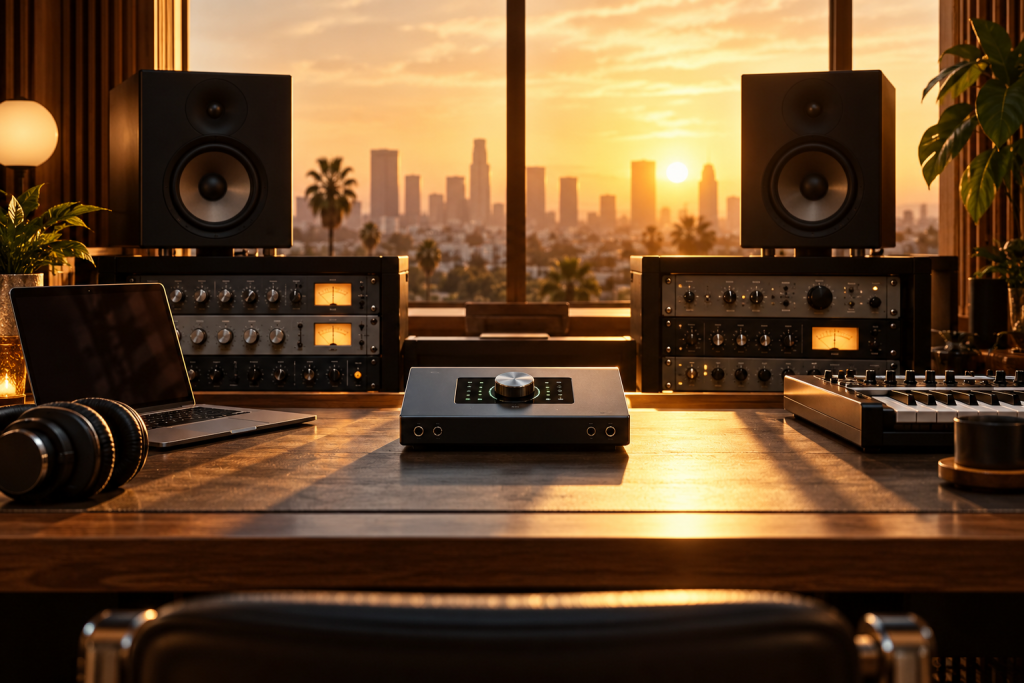
I bought an Apollo Twin X Duo in 2019 and have run every session through it since, so the DSP-versus-native question is not abstract for me. It is the reason I have kept a Thunderbolt cable plugged into a Mac for six years and the reason I have occasionally stared at my plugin folder wondering if I was being sentimental. Here is how I actually think about it in 2025.
The short version: the Apollo ecosystem still justifies its price, but for a narrower set of reasons than it did five years ago. Native plugin quality has climbed to the point where I no longer reach for UAD by default on every channel. The things I still can’t replicate natively are specific: low-latency tracking through modelled preamps, and a handful of emulations that Universal Audio does better than anyone else.
The thing native cannot do: Unison on the way in
This is the core argument and it hasn’t weakened. Apollo interfaces deliver their conversion through UA’s Unison preamps. Those preamps can be reconfigured into emulations of classic channel strips, processors, or amp models that change the behaviour of the analog circuitry itself while simultaneously applying digital modelling, and the result can be printed to the audio in your DAW on the way in.
I record a lot of vocals and a fair amount of DI bass. The difference between tracking a vocal through a native 1176 after the fact and tracking it through a Unison emulation that is actually loading the preamp is not subtle in the way it sits in a mix. The hardware responds differently to how hard I drive it. That is not something a native plugin can give me because the plugin never touches the analog stage.
If you only work in the box with soft synths and samples, this argument evaporates. It is worth saying plainly. Half the producers I know who own Apollos could have bought a Scarlett and been just as happy, because they never track anything through a mic. The DSP story is a tracking story first.
The plugin library is still the strongest card in the deck
Universal Audio’s background is in recording hardware, and the accuracy of the DSP-powered effects reflects that. The recreations of legendary reverb units like the Lexicon 480L and delays like the Roland Space Echo are the tools my hands reach for first. The 480L in particular is a hall I have not found a convincing native match for, and I have tried the obvious candidates.
Where it gets awkward is that many of the best UAD plugins now also run natively. UA itself has been porting its catalogue to native versions for a few years, which means the reason to buy an Apollo is no longer access to the plugins. It is access to running them on DSP during tracking without adding buffer latency. That is a real distinction, and it is the one that matters.
The Twin X Duo I own gives you a pair of mic/line ins, four outs on the line side, plus optical, and it lands in 2-core or 4-core trim so you can pick your processing muscle to taste. I have the Duo, which is 2-core, and I run out of DSP on a full tracking session with a couple of reverbs and a channel strip loaded. If you are tracking a full band in one pass, the Quad is not overkill. I underestimated that when I bought.
Where the price argument starts to fray
The Twin X Duo sits at £769 at the time of writing. That is not cheap for an interface with two inputs. You can buy a lot of native plugins for the difference between that and a comparable non-DSP interface, and if your tracking needs are modest, that math can favour the cheaper box.
The other issue is that the UAD ecosystem ties you to Universal Audio’s hardware and its pricing on plugins. UA has been aggressive with sales in recent years, but the list prices on individual emulations are still steep, and I have bought things in bundles that I would never have paid full freight for. This is a real friction point. It is not a dealbreaker, but it is worth going in with eyes open.
What I would tell a producer deciding today
Two questions, in order.
Do you track real instruments or voices through microphones regularly, and do you care about the sound of the input stage? If yes, the Apollo argument is strong and the price is defensible. The Unison preamps and the DSP-on-tracking workflow are still a genuine advantage.
Do you mostly produce in the box with samples and soft synths and only occasionally record a vocal? If yes, buy a clean interface and spend the difference on native plugins. You will not miss what you never used.
There is a middle case that is easy to overlook: producers who value the specific UAD emulations enough to want them regardless of tracking. In that scenario the Apollo becomes a dongle that also happens to be a very good interface, which is not the worst way to look at it. The 480L alone has justified the hardware for me on more than one project.
The honest state of play in 2025
Native plugin quality has never been higher, and the Apollo ecosystem has not kept the same lead it had in 2015. But the lead it retains is in the exact place that matters most to me as a producer who tracks, which is the front end. That is a narrower justification than it used to be, and Universal Audio knows it, which is why it has been porting so much to native.
If I were buying my first proper interface tomorrow with my own needs in mind, I would still buy the Apollo. If I were buying for a friend who makes beats in a bedroom and never plugs in a microphone, I would tell them to save the money. The ecosystem is worth the ask, but only if you are actually going to use the part of it that no one else can sell you.